Use Green manure or FYM to overcome the deficiency of organic matter in soil.
Quantity on the basis of soil fertility.
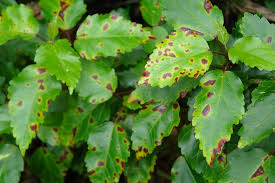
Boron Deficiency.
Boron deficiency can be treated by spraying 100gm of Boron per acre before flowering or by using 400gm of Boron per acre during sowing.
ZINC AND BORON DEFICIENCY OF COTTON
Zinc and boron can also be sprayed in the field if symptoms of deficiency are visible. In this case, spraying should be done at about 45, 60 and 90th day of seed sowing. The formulation can be easily made as follows; Boric acid - 300 gram Zinc sulfate (33%) - 250 gram Sodium bicarbonate (ordinary caustic soda) - 50 gram Water - 100 litres Mix them in a tank and spray in the field. Pesticides should not be mixed in this solution for spraying. Spray the field in the morning or evening only because spraying in mid day can cause burning of leaves.
For Early sowing,
Nitrogen should be applied in 6 splits. First, with sowing, 2nd after 30-35 days of sowing and later nitrogen dose should be given at the gap an irrigation each.
For sowing in May,
Split nitrogen in 4 doses. First dose with sowing, 2nd after 30-35 days of sowing, 3rd at the formation of floral buds, and 4th at boll formation. Phosphatic fertilizer should be used mixed with farm yard manure (FYM). Green manuring should be done to increase the organic matter contents of the field which will be helpful to increase effectiveness of the fertilizer application. It has been found that fertilizer application during evening is more beneficial. In case of viral attack, half bag of urea should be given with initial four irrigations.
Urea
3 bags for Bt cotton, while 2 bags for non-Bt cotton
DAP
2 bags for Bt cotton, while 1.5 bag for non Bt cotton
Nitrophos and SOP
Nitrophos 3.5 bags, 2 bags urea ans SOP 1.25 bags for Bt cotton and 1 bag for non Bt cotton.